Attach documents
Google must change the procedures and forms available to users, allowing them to attach documentation in support of their de-indexing request.
Every person has the right not to be forever defined by a mistake, a suspicion, or a lie.
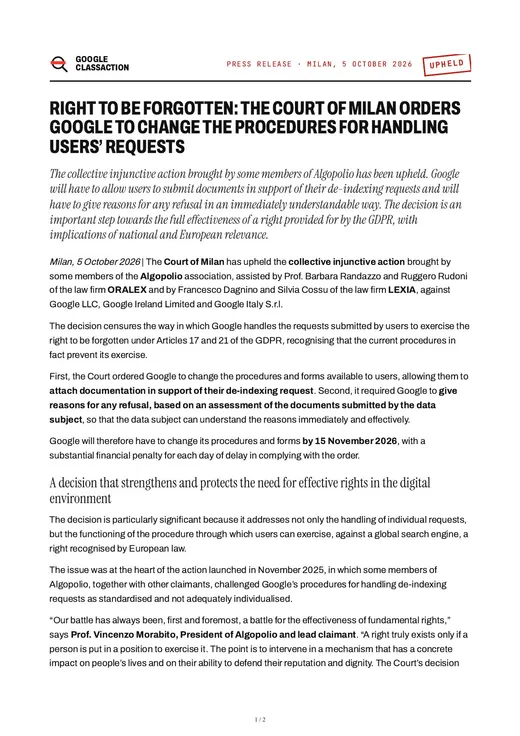
Google will have to allow users to submit documents in support of their de-indexing requests and give reasons for any refusal in an immediately understandable way.
What the Court ordered
Google must change the procedures and forms available to users, allowing them to attach documentation in support of their de-indexing request.
Google must give reasons for any refusal based on an assessment of the documents submitted by the data subject, so that the reasons can be understood immediately and effectively.
“A right truly exists only if a person is put in a position to exercise it.”
The class action against Google challenges the systematic rejection of de-indexing and removal requests, through standardized and non-personalized procedures, also adopted in substantial circumvention of specific provisions of the Italian Data Protection Authority.

Some members of the Algopolio association, together with other citizens, assisted by lawyers Francesco Dagnino and Silvia Cossu of the LEXIA law firm and by lawyers Prof. Barbara Randazzo and Ruggero Rudoni of the ORALEX law firm, have filed a collective injunctive action against Google LLC, Google Ireland Limited and Google Italy S.r.l.
“It’s not just about removing isolated links, but about interrupting the systemic mechanism that allows false information to spread and remain accessible for years, transforming insinuations and errors into ‘digital truths’ that are difficult to erase.”
— The lawyers involved
Dear user, we have reviewed your request. Based on the information provided, we have decided not to take action on the reported URLs.
— The Team
RejectedWe are not asking for compensation, but for a principle: a human interlocutor cannot be missing when evaluating people’s rights.
Illustrative reconstruction of the conduct challenged in the claim. Names, texts and results are fictional.
Google ClassAction was born from a group of people who for years have silently fought against a machine that doesn’t listen. Each of them has a different story, but the same pain: being reduced to a link, a page, a prejudice that regenerates itself every time someone types their name.
Behind every indexed fake news, there is a suspended life, a lost job, a distorted identity. This initiative was born to transform that suffering into civil action, to give victims their voice back and to raise public awareness that the power of algorithms cannot be absolute.
The class action alleges that Google systematically and structurally adopts an illegitimate de-indexing procedure that violates the GDPR and the fundamental rights of a very large number of people.
Google’s procedure does not allow submission of documents demonstrating the falsity, outdatedness, or illegality of the content to be de-indexed, effectively nullifying the right to be forgotten.
The responses are standardized, impersonal, identical, and devoid of any reference to the specific case; Google does not perform any balancing of conflicting rights, as required by Articles 17 and 21 of the GDPR.
Google does not explain why it rejects requests and does not offer any human contact, suggesting a fully automated process that may violate Article 22 of the GDPR.
Google does not remove all linked URLs or equivalent variations, compromising the effectiveness of the right to be forgotten.
These conducts, according to the claim, are not isolated errors but systematic violations, capable of affecting an indefinite number of citizens, and therefore perfectly suited to a class action.
Search engines, while claiming to be mere intermediaries, claim they have no responsibility for the content. However, each result demonstrates how algorithmic choices can amplify falsehoods, create arbitrary correlations, favor certain sources, and resurface previously debunked information.
This doesn’t represent neutrality, but rather information orientation. And when truth is being oriented, we find ourselves faced with a new form of power: unelected, uncontrolled, and potentially decisive.
“Unelected, uncontrolled and potentially decisive.”
Every person has the right not to be forever defined by a mistake, a suspicion, or a lie. The European Court of Justice and the Italian Supreme Court have recognized that the right to be forgotten does not erase history, but restores proportion and context.
Google, however, continues to store, index, and repost content that has already been dismissed or archived by the courts, perpetuating a damage that is renewed every day with every search.
“When a lie remains online for years, it is no longer information: it is a civil sentence without appeal.”

The individuals involved in this class action have lost contracts, customers, job opportunities, and personal relationships. Many have suffered profound psychological damage, compounded by the inability to defend themselves from an automated system that neither listens nor responds.
The Milan Court has already recognized in several cases that Google’s late de-indexing constitutes a source of compensable damage. This class action seeks an injunction: a judge’s order to halt the infringement, de-index fake news, and enforce digital rights.
“That dignity not be sacrificed for indexing.”
The first challenged conduct concerns the way the search engine handles all de-indexing requests: through automatic, pre-populated, impersonal responses that are identical for every user, without any concrete analysis of the facts. The procedure is structurally inadequate and violates the individual assessment requirements imposed by the GDPR.
The second point calls on Google to establish a rapid review and response protocol for all complaints related to false or harmful content. Today, those who suffer digital harm are forced to interact with automated systems that fail to respond, fail to explain, and fail to assume responsibility. The injunction aims to introduce a transparent mechanism, with clear deadlines and reasoned decisions, that guarantees human and verifiable review.
The third point aims to stop the automatic repetition of the damage: Google must no longer allow content already recognized as false or defamatory to be reposted under other domains or links. The algorithm currently tends to replicate and repost duplicate articles, creating an endless chain of negative visibility. The injunction calls for the adoption of preventative technical measures to block this cycle, requiring Google to act diligently and responsibly.
Court of Milan
A group of citizens, assisted by the law firms LEXIA and ORALEX and supported by the Algopolio association, brings the collective injunctive action before the Court of Milan. The news is covered by the national press.
A hearing on the action is held before the Court of Milan: the Court sets the procedural timetable.
Deadline for the claimants to file concise written observations in reply to the defence briefs submitted by Google.
Deadline for Google to file concise written observations in response to the claimants’ reply.
Substantive discussion of the injunctive action: the first confrontation on the core issues raised by the claimants.
The Court of Milan upholds the collective injunctive action and orders Google to allow users to attach documentation in support of de-indexing requests and to give reasons for any refusal based on the documents submitted.
By this date Google must change its procedures and forms, with a substantial financial penalty for each day of delay in complying with the order.
Press release · 5 October 2026
The official press release on the decision of the Court of Milan, ready to download and quote. For interviews, background and materials, contact the press office.


ALGOPOLIO is an independent association that brings together jurists, technologists, artists and ordinary people around a simple and radical idea: the power of the algorithm cannot be worth more than human dignity. We fight for a web where people are not numbers to be profiled, but individuals to be protected; where automated decisions are transparent; where reputation, data and freedom are not at the mercy of a few global players.
Visit algopolio.com“This action does not concern only the individual claimants, but touches the fundamental rights of every Italian and European citizen. For too long, the imbalance of power between global platforms and citizens has made it difficult to obtain protection.”
We are collecting reports. Tell us about your experience: every story strengthens an action that concerns everyone.